How Adhesion Is Measured: 180° Peel Test, GB/T 2792 and ASTM D3330 Explained
Peel strength numbers mean nothing without test conditions. Learn the three tests we run per batch and how to compare quotes honestly.
Two suppliers can quote the same '300 g/in' and mean completely different things. Adhesion is not a material constant — it is a measurement that depends on speed, angle, temperature, dwell time and substrate. If you want to compare offers honestly, ask which test standard and conditions produced the number.
**The 180° peel test.** The most common method for protective films: laminate the film onto a standard test panel (usually stainless steel or glass), condition it for a defined time, then peel it back at 180° at a fixed crosshead speed (commonly 300 mm/min) and record the average force in g/in or N/25 mm. Peel force usually stabilises after the first few centimetres, so the initial spike is discarded.
**Relevant standards.** For pressure-sensitive tapes the widely used references are **GB/T 2792** (China) and **ASTM D3330** (international), which specify panel preparation, roller weight, dwell time and peel geometry. When you ask any supplier for adhesion data, ask them to state the standard, peel speed and dwell time along with the value.
**90° and T-peel variants.** Some applications — curved profiles, films that are removed by folding back sharply — correlate better with 90° peel measurement. If removal happens by machine at high speed, ask for data measured at a speed closer to your line, because peel force rises with peel rate for most acrylic systems.
**Conditioning matters.** A 20-minute dwell gives a very different result from a 24-hour dwell, and a 24-hour dwell at 23 °C differs from one at 60 °C. Realistic comparison means testing under conditions that match your actual storage: same temperature, same dwell time, same panel material.
**What we measure per batch.** For every production lot we record: peel strength before and after heat ageing, thickness, tensile strength and elongation, plus a visual check for coating uniformity. Batch records are kept so a shipped roll can be traced back to its raw materials and test data. Third-party testing (SGS / RoHS / REACH) can be arranged per order requirements.
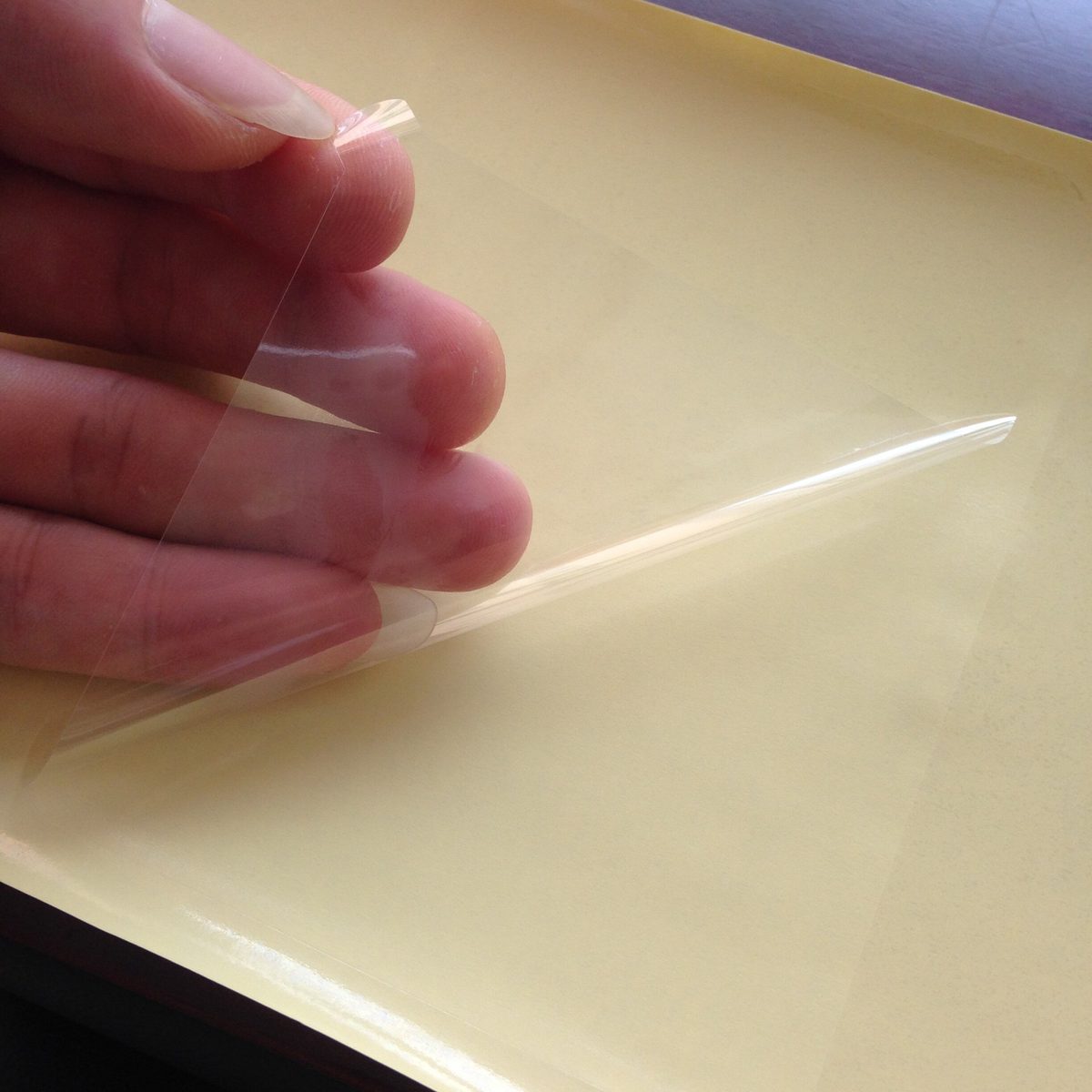
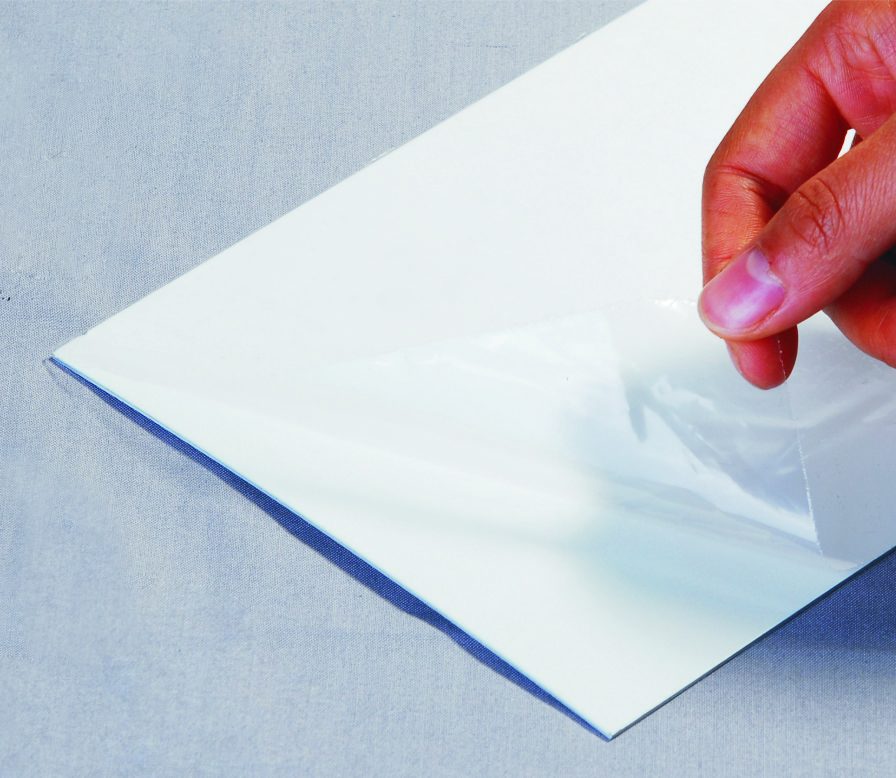
**How to run your own check.** You do not need a laboratory to catch obvious mismatches. Laminate a sample on your real substrate, leave it for your real dwell time under your real conditions, then peel by hand and look at three things: resistance you feel, whether the film stretches or tears, and whether any adhesive stays behind.
**Interpreting results.** Clean removal with no residue and moderate initial force means the adhesion is in range. If the film lifts at the edges or falls off during transport, you need a higher tack grade. If adhesive transfers to the panel or removal needs solvent, you need lower tack or a different adhesive system.
Ask us for a sample roll of two or three adjacent grades and run this check side by side — it takes a week and removes most of the guesswork from a long-term specification. We will send test reports for the same production lot on request.